Hesam Rahmanian
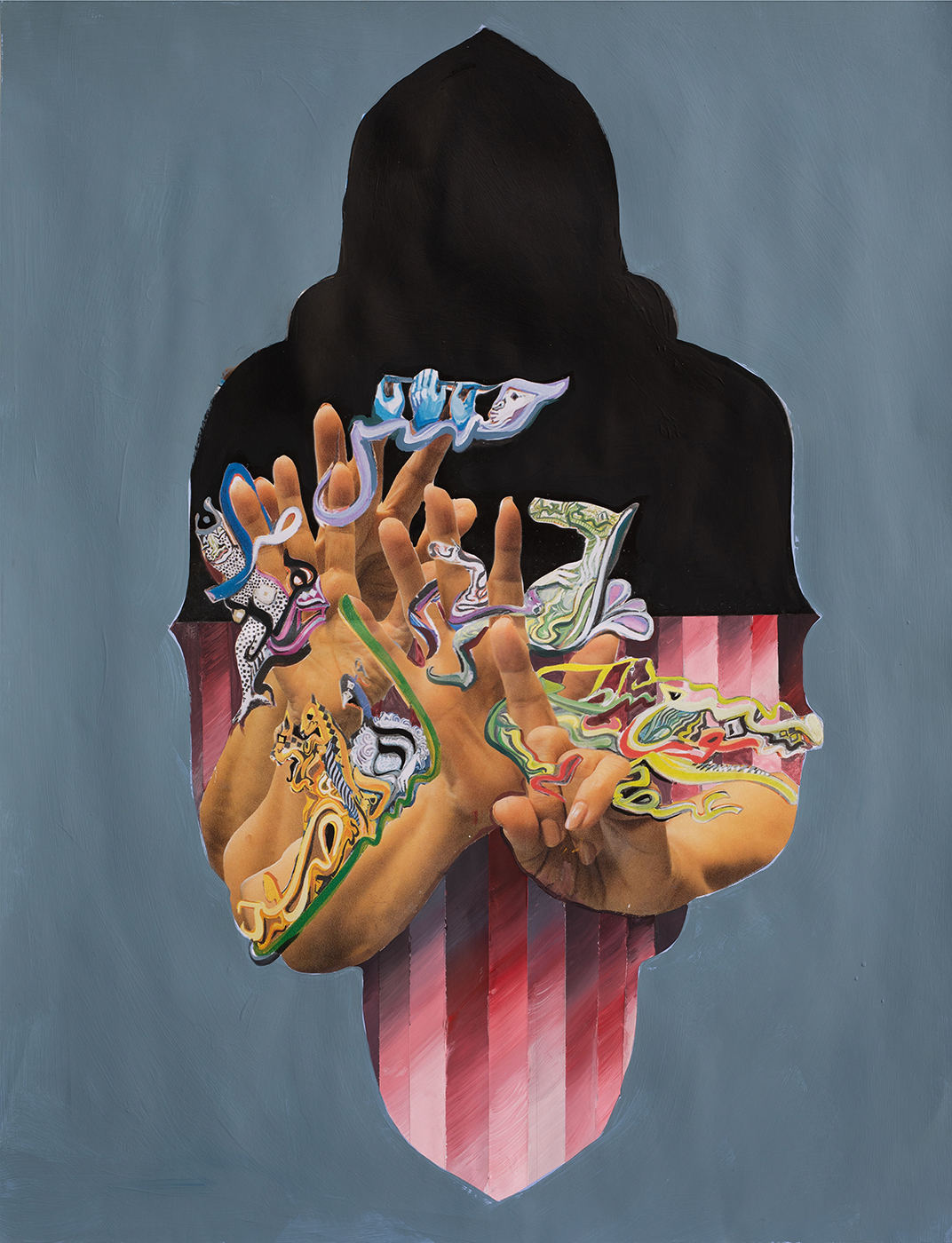
Ramin Haerizadeh, Rokni Haerizadeh, Hesam Rahmanian
Luminous Shadow, 2025
Acrylic, collage on paper
58 x 45 cm ( 69 x 56 x 4 cm framed )
Unique artwork
LUMINOUS SHADOW
Through its structure, Luminous Shadow extends the inquiry into form and formlessness from theory into practice. It explores how ideas from Islamic metaphysics can re-emerge through the region?s material reality to build a narrative based on a history that is living.
The work sees itself as a framework, in which reappears within the landscape of the region, shaping a renewed narrative of its present history. It uses philosophy to translate matter and form within the desert?s living terrain.
Luminous Shadow unfolds across three planes of being in Islamic metaphysics and mysticism: Nasut (the material and visible world), Malakut (the imaginal and intermediary realm), and Hayula (primordial, formless matter). Tools to inquire form, formlessness, and substance, they are trying to rediscover, how existence shifts between formed and unformed states.
The work begins in Nasut, the earthly realm. A finger, made of layered plywood and collage, stands as the primary tool. It is a vehicle of migration (Hijra) in the sense given by Ibrahim al-Koni: to exist anew, one must depart from what one once was.
The finger is not a pedestal but a means of passage, a bridge between intention, the mental, and the material world, carrying clusters of letters that are no longer written to be read but to become.
Within Malakut, these letters hover between text and image. Each cluster holds fragments from Ibn ?Arabi: ?How exquisite this darkness is, how intense its light, how radiant its brilliance. This darkness is the source of lights, the wellspring of the eyes of secrets, and the element of all substances. From this darkness I created you, and to it I shall return you, and I will not bring you out of it.?
Meaning condenses into structure; language becomes bone.
Behind the sculpture, the surface is entirely flat, coated in fluorescent orange paint. When lit, it casts a neon reflection onto the wall?an immaterial extension of the work. This glow gestures points toward Hayula: the primordial, unformed substance, the first matter of existence. It is not light as symbol but matter in potential, the feminine mud before animation.
Through these transitions?from the tangible wood of Nasut, to the suspended letters of Malakut, to the orange field of Hayula? Luminous Shadow becomes a philosophical journey: a sculptural investigation into how form migrates through matter, and how matter itself begins to think.